
Every finance transaction, every streaming play, and every question asked to an AI have one thing in common: they pass through a building most of us will never see. The data center has become the most contested real estate asset on the planet for a simple reason: the digital economy depends on a scarce and physically located resource—space with abundant, affordable electricity and viable cooling. Whoever controls that square footage controls the capacity to process data.
It has become common to treat digital transformation as something immaterial. We talk about the cloud, algorithms, and code as if technology floated above reality. But behind each of these elements lies massive-scale engineering—concrete, cables, substations, and cooling systems. There are about 12,000 facilities spread across 179 countries, with demand projected to nearly triple by 2030 and require $7 trillion in global investment. These buildings have moved from being operational backdrops to taking center stage in the global economy.
The problem is that the math doesn't add up with concrete alone. Digital demand is growing faster than the capacity to generate power and provide water for cooling—and that is where software enters as the decisive variable.
Summary of key points
- There are about 12,000 data centers in 179 countries, with the U.S. accounting for up to 50% of them.
- Global demand is expected to nearly triple by 2030, requiring $7 trillion in investment.
- In 2026 alone, Amazon, Microsoft, Alphabet, and Meta are expected to spend a combined $700 billion on AI infrastructure.
- The Brazil leads Latin America with 205 data centers (42% of the region) and is expected to attract $33 billion by 2030.
- The sector's electricity consumption is expected to more than double by 2030 (from 415 TWh in 2024 to 945 TWh, according to the IEA).
- With physical limits approaching, efficient software is no longer just a technical detail but an economic variable.
What is driving the expansion of computing hubs
Three factors explain the current race:
1. AI demand. Training and running generative models require processing density far greater than that of conventional applications. An AI rack can consume several times more power than a traditional rack, which completely changes the electrical and thermal design of the facility.
2. Cloud and streaming. Corporate migration to the hybrid cloud and 4K and 8K video traffic are continuously increasing bandwidth and storage consumption.
3. Technological sovereignty. Countries and economic blocs have realized that digital autonomy depends on controlling physical infrastructure. Latency, data jurisdiction, and national security have begun to justify investments that would previously have been purely private.
From billions of dollars to Brazil's leading role
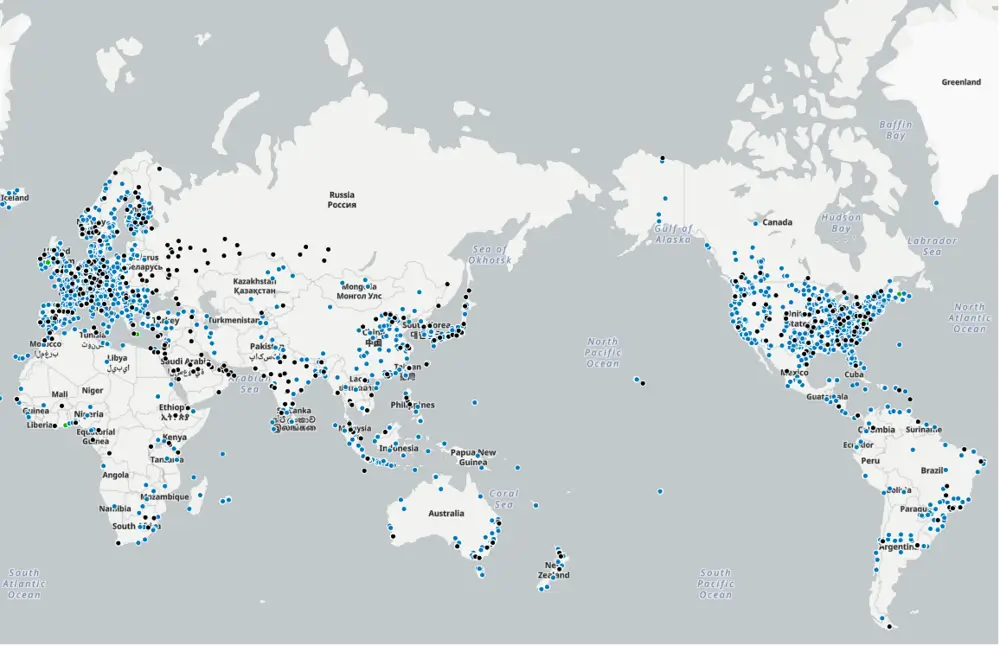
The Data Center Map identifies about 12,000 facilities in 179 countries, with the United States accounting for up to half of them, followed by the United Kingdom, Germany, and China.
While an average facility occupies 100,000 square feet, hyperscale complexes from Big Tech companies exceed 10 million square feet—the equivalent of more than 120 soccer fields. In 2026 alone, Amazon, Microsoft, Alphabet, and Meta are expected to invest a combined $700 billion in AI infrastructure.
Latin America is gaining traction precisely because of what traditional hubs lack: a renewable energy matrix. According to the JLL Latin America Data Center Report, Brazil leads the region with 205 data centers, 42% of the total, ahead of Chile and Mexico. According to the Global Data Center Outlook 2026, the country is expected to attract $33 billion in new investments by 2030.
For those making technology architecture decisions in Brazil, this has a practical effect: more local capacity, lower latency, and new options for data residency within the national jurisdiction.
The electrical and water limit and the sustainability imperative
Although engineering is advancing, the sector's main challenge remains rooted in the physical world: the availability of electricity and fresh water.
According to projections by the International Energy Agency (IEA), the global electricity consumption of data centers is expected to more than double by 2030, jumping from about 415 TWh recorded in 2024 to nearly 945 TWh, driven by AI-optimized servers.
In the United States, scenarios from the Electric Power Research Institute (EPRI) indicate that the sector could account for 9% to 17% of all electricity consumed in the country by 2030—a significant increase from the 4% recorded in 2023. In high-concentration hubs, such as the state of Virginia, EPRI studies show that data center demand is already threatening to exceed 50% of the entire regional electrical load.
On the water side, technical industry surveys indicate that large facilities consume up to five million gallons of water per day. It is this figure that is fueling the search for alternative cooling solutions—liquid, immersion, or non-potable sources.
The bottleneck has shifted
Historically, the limit of computing was the chip. Today, it is the power outlet. Data center projects are now approved or blocked by the capacity of the nearest substation, not by the availability of land or hardware. This reversal explains why the sector has begun to operate like the real estate market: what is being contested is the point where energy, water, and connectivity meet.
Beyond solid ground: sky and sea as new frontiers
Faced with the depletion of space and energy on land, tests have begun outside traditional urban centers.
At sea: in the Lin-gang special area in Shanghai, Shanghai Hicloud and CCCC operate the world's first commercial underwater data center. Powered by offshore wind energy, the system uses ocean water for cooling, without consuming fresh water.
In the sky: Google is developing Project Suncatcher to run AI chips (TPUs) on solar-powered satellites communicating via laser. After validating the chips' radiation resistance in particle accelerators—the equivalent of five years of exposure—the company plans to launch two prototype satellites in 2027, in partnership with Planet, to test orbital computing.
The race for space, competitive energy, and efficient cooling is reshaping where and how the planet processes data.
The new engine of technology is software
There is one point that is often left out of this debate, and it is the one that matters most to those who develop technology.
"Physical infrastructure cannot keep up with digital demand without exhausting resources. It is in software that the math works out, by optimizing algorithms to deliver high performance with rationalized energy consumption."
Building a new data center takes years and depends on permits, transmission lines, and water availability. Rewriting an inefficient algorithm, adjusting an inference pipeline, or reducing a model's size takes weeks—and frees up capacity immediately.
In other words: software efficiency is currently the fastest way to expand computational capacity. Every CPU cycle saved, every quantized model, and every optimized query represents watts that do not need to be generated, transmitted, or dissipated.
This is the layer where Venturus operates. Our high-performance software engineering works exactly where the infrastructure math works out: extracting maximum computational yield from every watt consumed—whether in embedded systems, IoT solutions, or large-scale artificial intelligence applications.
The data center may be the most sought-after real estate in the world. But those who know how to make good use of the space that already exists will have less need to compete for it.