
The pressure for greater speed, traceability, and precision in logistics operations is a growing reality for manufacturing and distribution companies.
When product volumes rise and portfolios diversify, manual processes reach their breaking point—leading to downtime, rework, and excessive dependency on operators. This is where automation through advanced robotics enters as a strategic response.
In this article, we explore how an automated labeling project developed by Venturus transformed a real-world production line, applying core Industry 4.0 concepts to solve concrete logistics challenges.
The Breaking Point of Manual Logistics Processes
Many logistics operations still rely on manual adjustments to handle variations in the product portfolio. When the mix is broad—such as boxes of different sizes and weights—each variation requires human intervention to reconfigure the labeling process.
In the case that inspired this project, the client operated a line with high packaging diversity. As demand grew, the issues became more evident:
- Constant manual adjustments for every packaging variation;
- High dependency on operators, creating production bottlenecks;
- Frequent downtime and rework compromising line efficiency;
- Lack of traceability integrated with management systems.
These factors made it clear that the manual model could not sustain the operation's growth. It was time to evolve toward automated logistics with real-time control over every stage.
The Technical Challenges of Automated Labeling
Automating labeling on a high-variability line is no small feat. The system must be able to adapt to the process without requiring manual reconfiguration for every packaging change. Four core challenges guided the project:
Adaptability to the Portfolio
The system needed to handle boxes of various dimensions and weights, automatically identifying each unit’s characteristics without operator intervention.
Labeling Standardization
Misplaced labels compromise automatic reading by scanners and management systems. The solution had to guarantee precise application with total repeatability throughout the line.
Continuity and Productivity
Unscheduled downtime and manual interventions break the production rhythm. The goal was to eliminate these friction points and maintain continuous flow, even with product variation.
Traceability and Integration
For true operational control, labeling data had to be integrated with the client’s management systems, such as MES and ERP. This would allow for real-time tracking of every package from start to finish.
The Solution: A Pick-and-Place System for Logistics
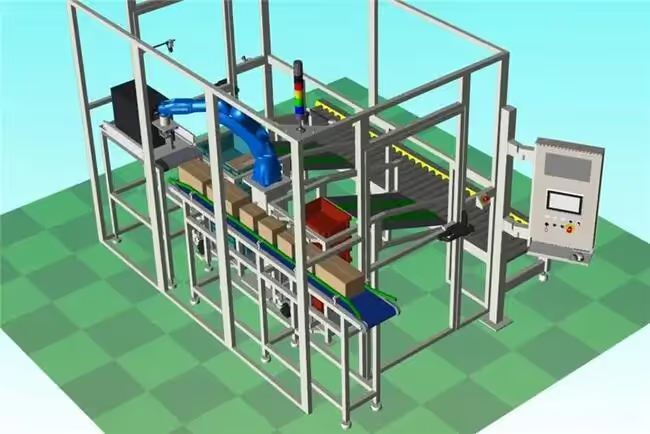
Venturus developed an automated Pick-and-Place system dedicated to labeling and package organization, fully integrated with the conveyor and the client's management systems. The solution combines advanced robotics, computer vision, and data integration to operate with minimal human intervention.
1. Automated Identification and Inspection
At the line entrance, the system identifies the position, orientation, and dimensions of each SKU in real time. The robot handles and inspects the volume without manual adjustments, regardless of box size or weight.
2. Precise and Validated Labeling
Based on the package identification, the robot applies the label at the correct spot, ensuring standardization and repeatability in every cycle. The system then validates the application, ensuring compliance and real-time traceability. This eliminates the primary source of errors that used to compromise automated reading.
3. Organization and Flow Continuity
After labeling, packages are organized and automatically directed back to the conveyor for the next stages of the process. The result is a continuous flow with fewer errors and greater operational control, independent of operator availability.
Results: Automation in Practice
Implementing the automated labeling system had a direct impact on operational metrics:
- Increased line productivity, with more packages processed in the same timeframe.
- Significant reduction in manual adjustments and unscheduled downtime.
- Full labeling standardization, eliminating placement errors.
- Improved traceability, with data seamlessly integrated into the MES and ERP.
Beyond immediate gains, the project established a structured operational database. This data can now be used for advanced analytics, demand forecasting, and continuous improvement decisions. This is a pillar of Industry 4.0: transforming operational data into business intelligence.
Acess this sucess story here.
Why Advanced Robotics is Central to Industry 4.0
Projects like this illustrate what Industry 4.0 truly represents: it is not about replacing people with machines, but about reallocating human intelligence to where it adds the most value, while automated systems handle repetitive, variable, and high-volume tasks with superior precision.
Advanced robotics, when integrated with computer vision and management platforms, creates an operational environment where variability is no longer a problem. The system adapts to the product, rather than the other way around.
For sectors like manufacturing, distribution, and logistics, this adaptability is what distinguishes operations that scale from those that stagnate.
Conclusion
Automating logistics labeling isn't just "technology for technology’s sake." It is a direct response to a business problem: operations growing in complexity faster than manual processes can keep up.
With advanced robotics, computer vision, and data integration, it is possible to transform a production line vulnerable to errors and downtime into a reliable, traceable, and scalable process.
This is the type of solution Venturus develops. If your operation faces similar challenges, talk to one of our specialists and discover how we can help.